
I Will Be Okay. Always.
“I will be okay no matter what happens.”
Chris Williamson described that as a definition of safety.
Most people hear comfort in that sentence.
I hear exposure.
Because if that sentence is true, a lot of illusions collapse.
Most people think safety means:
Nothing bad will happen.
Nobody will leave.
The money will stay.
The plan will work.
The room will approve.
That isn’t safety.
That’s control.
And control is fragile.
Control says, “I’ll be fine as long as everything behaves.”
Real safety says, “Even if it doesn’t, I can.”
That’s internal.
That’s earned.
That’s dangerous to a world built on fear.
Real safety is the nervous system saying:
Even if this goes wrong.
Even if I’m rejected.
Even if I lose something.
Even if this hurts.
I will be okay.
Notice what that sentence removes.
It removes the guarantee.
It removes the promise of comfort.
It removes the illusion of certainty.
And it replaces it with capacity.
That’s a different operating system.
When safety depends on outcomes, you cling.
You cling to relationships because you fear abandonment.
You cling to income because you fear instability.
You cling to reputation because you fear rejection.
You cling to identity because you fear irrelevance.
You move carefully.
You filter your words.
You avoid the arena.
You call it wisdom.
It’s fear wearing a tie.
When safety depends on capacity, posture changes.
You speak even if it costs you.
You build even if it might fail.
You stay present under pressure.
You leave when leaving is required.
You don’t move recklessly.
You move deliberately.
For anyone who knows me, when I’m asked if I’m okay, my answer is simple:
“Always.”
That line gets misunderstood.
People assume it means I’m unaffected.
It doesn’t.
It means I trust myself.
It means I’ve seen enough of life to know that pain does not equal destruction.
It means I’ve been stretched before and survived.
There were seasons I didn’t feel that way.
Moments where outcomes felt like identity.
Where loss felt like erasure.
Where failure felt permanent.
In those moments, safety meant control.
And when control slipped, anxiety flooded.
That’s not weakness.
That’s biology.
If the brain believes something threatens survival, it activates defence.
Heart rate rises.
Vision narrows.
Thinking reduces to threat management.
You don’t become irrational.
You become protective.
The problem is this.
If your definition of safety is “nothing bad happens,” your nervous system lives on edge.
Because something always might.
Markets shift.
People change.
Health moves.
Reputation wobbles.
Life does not sign contracts promising comfort.
So if safety depends on predictability, you never relax.
But if safety depends on capacity, something powerful happens.
The nervous system recalibrates.
Threat becomes challenge.
Pressure becomes responsibility.
Discomfort becomes information.
You don’t eliminate stress.
You metabolise it.
That is resilience.
And resilience is built, not wished into existence.
You build it by collecting evidence.
By training when you don’t want to.
By having the hard conversation.
By keeping promises to yourself.
By surviving what you thought would break you.
Every time you do something difficult voluntarily, your biology updates.
“I can handle this.”
The brain believes experience.
Not slogans.
That’s why affirmations feel hollow when there’s no proof behind them.
Confidence without evidence is noise.
Confidence with scars is stability.
And here’s where this becomes disruptive.
If you genuinely believe you will be okay no matter what happens, fear loses leverage.
Fear is the currency of control.
If I can convince you that you will collapse without this job, this person, this identity, I own your behaviour.
If you know you will survive regardless, that leverage disappears.
You stop negotiating with fear.
You stop shrinking.
You stop performing.
You start choosing.
This is not emotional shutdown.
It’s not stoicism misunderstood as numbness.
It’s integration.
You can feel hurt and still be okay.
You can feel pressure and still be okay.
You can feel uncertainty and still be okay.
That is strength.
Not the absence of emotion.
The capacity to carry it.
So when I say “Always,” understand what I mean.
Not untouched.
Not immune.
Not indifferent.
Capable.
It means life can hit.
It means plans can fail.
It means people can walk.
It means rooms can disapprove.
And I will still stand.
Not because nothing affects me.
Because I have built the capacity to respond.
Safety is not the world behaving.
It’s knowing that whatever it does, you can.
And when a man truly believes that, he becomes very hard to destabilise.
He stops living defensively.
He stops outsourcing stability.
He stops demanding guarantees.
He builds strength instead.
“Always.”
coming soon: april 2026
Secure your journey today with the Lion State Framework and see your mindset, habits, and life transform.
Step into Leadership—Transform Your Life Today Your transformation starts
now. With Lion State’s clear plan and supportive community, you’ll gain the clarity, confidence, and tools you need to lead with purpose and intention.
Fuel Your Mind
Get inspired, stay motivated, and challenge your perspective with these thought-provoking reads.

You Can Dent Me. But You Can’t Beat Me.
You Can Dent Me. But You Can’t Beat Me.There’s a line I once heard from Barry Hearn that has stayed with me ever since. “I’m unbeatable. You can dent me. You can hurt me. But you can’t beat me. I’m too happy not to exist.” At first glance it sounds like confidence....
When You Step Into the Arena, Everyone Is Watching
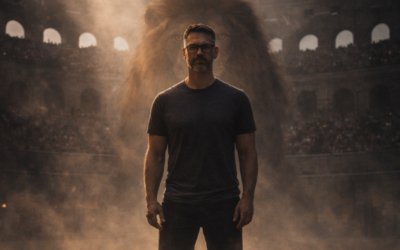
When You Step Into the Arena, Everyone Is WatchingRecently someone told me that standing on a stage and talking about what I’d been through sounded like playing the victim. I paused when I heard that. Not because it shocked me. If I’m honest, I’d always assumed that...

Women Are Not Asking for Weaker Men
Women Are Not Asking for Weaker MenInternational Women’s Day is about recognising the strength, contribution and progress of women. It isn’t about men. So let me be clear from the start. This isn’t a redirection of the spotlight. It’s an observation. Over the past two...